Maya Boutaghou
Professor and Director of Graduate Studies
Office Address
345 New Cabell Hall
Fall 2026 Office Hours
Tuesdays and Thursdays 11:30am-12:30pm and by appointment on Zoom
Education
- B.A. Lettres Modernes and FLE, Université Michel de Montaigne, Bordeaux III
- DEUG de Langue et Civilisation Arabes, mention « arabe littéral » [Diploma in Classical Arabic] Université Michel de Montaigne, Bordeaux III
- M.A. Université Michel de Montaigne, Bordeaux III
- Ph.D. (Doctorat) in Comparative Literature, University of Limoges
Grants and Fellowships
- Andrew W. Mellon, Global South Fellow at the Institute for the Humanities in the Global South, University of Virginia, 2016-2018
- Andrew W. Mellon, Summer Course Development at the Wolfsonian Museum of Art, Miami, Summer 2014
- Research Fellowship hosted by the Département des Lettres Modernes, March-April 2012, University of Orléans
- Andrew W. Mellon Postdoctoral Fellowship, Center for “Cultures in Transnational Perspective”, University of California Los Angeles, 2008-2010
Research Interests
Periods and areas: XIX to XXI century; Mediterranean Studies; North Africa, Egypt, Mauritius, Bengal.
Domains of interests: Comparative Literature; National and Cultural Identity construction in postcolonial contexts; Literary Theory and Aesthetics; Theory of the Novel; Theory of Postcolonial Subjectivity; Postcolonial Cultural Historiographies; Multiculturalism; Multilingualism; Cosmopolitanism; Identity politics and Gender Studies; Translation studies; World Literature.
From my earliest research, I have argued that most of the philosophical, critical, poetic, and conceptual categories used in postcolonial cultural studies are borrowed from Western epistemologies and that they are not conducive to rigorous critical interpretation in former colonized contexts. That is because they ignore minoritized endogenous conceptual knowledges, mostly manifested in silenced languages and fragmented forms of transmission. In other words, the philosophical approaches, critical categories, and methodological tools available through the history of Western critique need to be adapted to the local complexities and the epistemologies of cultural productions emerging within the experience of colonialism and its aftermath. While colonial languages as systems of knowledge have been reproduced in post-independence situations, my work aims to provide a deeper understanding of how systems of knowledge can be simultaneously de-colonized and informed or sustained by endogenous modalities of knowledge production and interpretation. This decolonial dimension of thought must happen at the level of the sign, which is the minimal unit of meaning production (for example, what does the notion of “public space” mean in other historical/cultural/linguistic situations?). My broad exposure to different cultural contexts grounded in 19th- and 20th-century colonial presence has given me a long-term, comparative historical perspective and a better understanding of aesthetic production as performative systems and manifestations of epistemologies informed by what Michel de Certeau refers to as “the practices of everyday life” in lived environments. A salient and consistent aspect of my work is that any theory of language needs to address the cultural history of linguistic use and performance as well as its geographical spaces. In short, I look at cultural production as a complex web of interactions between histories and landscapes, instead of a simple linear progression.
Monographs
- Boutaghou, M. (2024). White Tongue, Brown Skin: The Colonized Woman and Language. University of Virginia Press (234 pages).
Reviewed in Choice (October 2025)
“In White Tongue, Brown Skin, Boutaghou (French, Univ. of Virginia) privileges the work of four prominent women authors from the Global South—Assia Djebar from Algeria, May Ziyadah from Egypt, Toru Dutt from India, and Ananda Devi from Mauritius—addressing their conflicted relationship with their country's colonial language. Boutaghou examines each country's colonial history and the intricacies, ambiguities, and multiple facets of using the colonial language, probing how the four authors skillfully deployed it as a mode of mending, resisting, and reappropriating what their colonizers had violated. In the process, this created other layers of language. The author revives the idea of decolonizing the text/language to lessen the linguistic trauma when even a powerful language is bereft of its hegemonic bent. She illustrates the aggression that colonial language exerts on the native language and its culture, thereby creating spaces that need to be translated by the colonized. This well-researched book relies on rich critical theoretical approaches: its discussion of multilingualism, multiculturalism, and cosmopolitanism within colonial and postcolonial contexts is insightful. It is accessible to college students and would serve as an excellent reference on longstanding themes of identity, women, language and translation, colonization, and postcolonialism, among others.”- H. Bahri, The City University of New York, York College
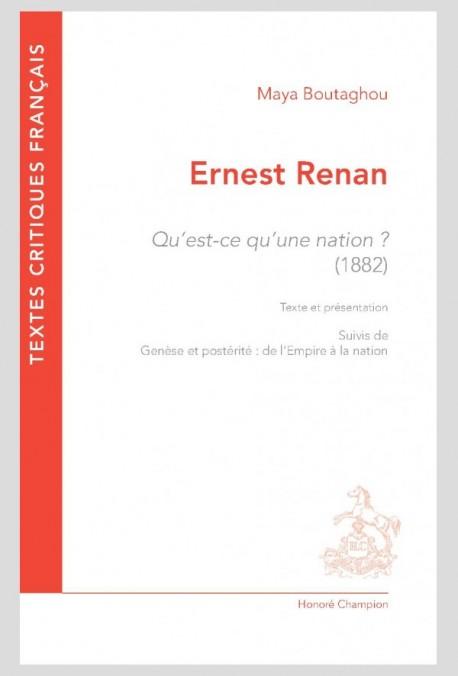
- Boutaghou, Maya (2020). Ernest Renan, Qu’est-ce qu’une nation ? (1882). Texte et présentation. Suivis de Genèse et postérité: De l’Empire à la nation. Paris: Honoré Champion (230 pages).
- Boutaghou, M. (2016). Occidentalismes, Romans historiques postcoloniaux et identités nationales au dix-neuvième siècle, Juan Antonio Mateos, Bankim Chandra Chatterjee, Jurji Zaydan, Marcus Clarke. Paris: Honoré Champion (517 pages).
Reviewed on Fabula: http://www.fabula.org/acta/document10485.php
Edited volumes, a selection
- Expressions Maghrébines, “Nouvelles historiographies algériennes”, vol. 22, issue 2, Winter 2023, Tulane University.
- Les lettres romanes, “Interroger le pouvoir herméneutique des littératures francophones”, Jean Bessier, Maya Boutaghou, Amaury Dehoux; 2021, Vol. 75 issue: 1-2, Brepols Publishers.
- Cultural Dynamics, the Minor in Question, Maya Boutaghou and Emmanuel Bruno Jean-François; January 2020, Vol. 32 issue: 1-2, Duke University.
Articles and Book Chapters, a selection
- Boutaghou, M. (2025). “Questions et méthodes appliquées à Ernest Renan, Qu’est-ce qu’une nation ? (1882), in Ernest Renan, une pensée complexe, Sophie Guermès (ed.), Peter Lang : Bern.
- Boutaghou, M. (2023). “Au commencement est le paysage : Les paysages visuels et sonores de Mohammed Dib”, in Le théâtre des genres dans l’œuvre de Mohammed Dib, Naget Khadda, Charles Bonn, Mounira Chatti, Rennes: Presses universitaires de Rennes, pp. 79-92.
- Boutaghou, M. (2023). “Introduction”, Expressions Maghrébines, “Nouvelles historiographies algériennes”, vol. 22, nº2, Winter 2023, pp. 7-18.
- Boutaghou, M. (2023). “Qu’en est-il du roman archéologique? La Femme sans sépulture d’Assia Djebar ou la Gradiva de Cherchell, Expressions Maghrébines, “Nouvelles historiographies algériennes”, vol. 22, nº2, Winter 2023, pp. 141-161.
Public Speaking
Participation, as an expert on nationalism and postcolonialism, in a documentary screened in major European channels (Canal +) and premiere at the College de France (Paris):
- Ernest Renan, Chantre de la nation by Jean-Michel Djian (2025)
- Renan, chantre de la nation, participation to France Culture, Public radio show, November 21, 2024: https://www.radiofrance.fr/franceculture/podcasts/toute-une-vie/renan-chantre-de-la-nation-4511070