

September 21, 2022
Join the French & Francophone club at UVA


October 21, 2022
Jazz at the Maison Française
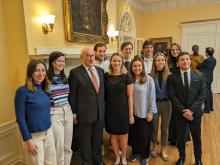
November 11, 2022
UVa students meet the French Ambassador to the U.S.
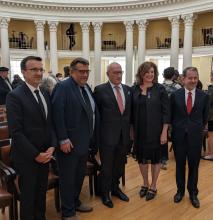
November 11, 2022
French Ambassador in the U.S. awards Prof. Janet Horne
Fall 2010 Undergraduate Courses
Expand content
Expand content
FREN 3030 - Phonetics: The Sounds of French
French 3030 is an introductory course in French phonetics, intended to present basic concepts in phonetic theory and teach students techniques for improving their own pronunciation. It includes an examination of the physical characteristics of individual French sounds, the relationship between these sounds and their written representations, the rules governing the pronunciation of "standard French", the most salient phonological features of selected regional varieties (e.g. le français méridional), and much more. Taught in French. Counts for major credit in French and in Linguistics.
Expand content
FREN 3031 - Intensive Grammar and Composition
Prerequisite: Completion of FREN 2020 or 2320 or exemption from FREN 2020 by the Placement Test; or a score of 3 on the AP French language exam; or a score of at least 660 on the SAT. Required as preparation for all subsequent courses except FREN 2933 and FREN 3030.
This course offers an introduction to narrative writing in French. Emphasis is placed on writing, revision, and an intensive review of grammar rules as they apply to oral and written communication. A variety of assessment formats include compositions, presentations, short quizzes, dictations, and a mid-term and/or final exam. Preparation and active participation are essential to improve reading, writing, and speaking skills. The course is conducted in French.
Expand content
FREN 3032 - The Writing and Reading of Texts
Prerequisite: French 3031. This course is a prerequisite for all undergraduate courses on a higher level except French 2933 and French 3030.
This course will prepare students for upper-level French courses by introducing them to the skills necessary to analyze literature and to express ideas in a written and oral form. Specifically, students will read literary texts from a variety of periods; they will learn to identify the elements that authors use to construct these texts; and they will learn the technical terms used to analyze poetry, prose, and theater. Grading will largely depend on the student's development of an analytical perspective on literature and on the student's ability to compose well-structured papers in correct French. The minimum writing requirement is a total of 10-15 pages for the semester, with at least one paper assignment of 5 pages. In addition, students will be expected to participate actively in order to advance their speaking skills in French. All discussion, readings, and assignments will be in French.
Expand content
FREN 3034 - Advanced Oral and Written Expression in French
Prerequisite: Students must have completed French 3031 and French 3032 or their equivalent. Counts for major/minor credit.
An intensive course designed to improve more advanced students' oral and written language skills. Assignments include discussion on topics of current interest, presentations, translations, and compositions. All materials are French- or Francophone-related. The course focuses on language development in a Francophone cultural context, so students can get familiar with French and Francophone cultures and comfortable in expressing their viewpoints in French. Of course, consistent attendance and active participation are essential.
Expand content
FREN 3042 - Royalty and Revolution
This course will present an overview of literature from the Ancien Régime period, most commonly associated with the reigns of Louis XIV and Marie Antoinette. Sometimes rebelling against church and state, sometimes flattering these institutions, the writers of this period sought above all to show the workings of human nature. In elegant and witty language, they explored the many possible outcomes that arose from conflicts between love, hypocrisy, family, vanity, and religion, among other factors. Readings for this course will include plays by Corneille and Molière, poems by La Fontaine and Voltaire, and other writings by the marquise de La Fayette, Pascal, and Diderot.Prerequisite: FREN 3032.
Expand content
FREN 3043 - Introduction to 19th-20th Century French Literature: Passion Disorders (Berard)
A survey of major literary works from the 19th and 20th centuries, this course will explore multiple representations of passion disorders, and more specifically of jealousy, in modern works of prose, poetry, theater, and film. What are the causes and effects of jealousy on a love relationship? From the suffering of a desperate lover to a the ridiculous behavior of a hysterical jealous husband, from desire to hatred, this course will examine the various psychological and physiological manifestations of jealousy on men and women, while focusing on the stylistic features of passion disorders.
May include literary works by Maupassant, Mérimée, Hugo, Baudelaire, Proust, Robbe-Grillet, Annie Ernaux.
Expand content
FREN 3051 - Histoire et Civilisation de la France Contemporaine
Beginning with a study of the French Revolution, this course focuses on the cultural and historical influences that have shaped Modern France. We will explore the relationship between culture and political power, the changing role of government, and how ordinary men and women experienced social change. Readings will be drawn from primary documents, memoirs and secondary historical texts. Visual elements will be incorporated in this course as well as selected films. Readings in this course will be done in both French and English. All lectures, discussions and writing will be done exclusively in French.
Expand content
FREN 3509 - Topics in French Linguistics
This course will explore a wide range of sociolinguistic issues relating to the French language and its role in societies around the world. Topics to be studied include: the diversity of the French-speaking world; the function of French in particular countries and regions (including Belgium, Canada, and Switzerland); the status of French in relation to other languages; individual language features; the "social meaning" of different styles and levels of language; French used by immigrants; and controversies affecting the French language, particularly in France itself. Requirements: group project; mid-term exam; term paper; attendance and daily oral participation. A sound knowledge of practical French is expected but no prior knowledge of socio-linguistics is assumed. The course will be taught exclusively in French. Some readings, however, will be done in English. FREN 3509 counts for major credit in French and in Linguistics Program.
Expand content
FREN 3584 - Topics in French Cinema
This course provides an introductory overview of French cinema from the silent era to the present. Emphasis will be placed on important directors and styles as well as on acquiring the vocabulary and analytical tools needed to produce excellent written work about film, in print and digital formats. FREN 3585 - French Non-Fiction: French Social Thought and the "Human Condition"
One of the great treasures of literature in French is the repertory of non-fiction prose: essays, letters, discourses, treatises, travel narratives and numerous other forms. This course proposes a sampling of such writings from the 16th century to today. To provide a thematic thread through the centuries, we will read mainly texts concerning society and the "human condition" in authors such as Montaigne, Descartes, Pascal, Sévigné, Rousseau, Diderot, de Staël, Tocqueville, Baudelaire, Fanon, Barthes, and Quignard. Four papers, one oral presentation, regular participation in class discussion. Prerequisite: FREN 3032.
Expand content
FREN 3753 - L'Immigration en France
L'immigration est un sujet de premier plan dans l'actualité quotidienne en Europe et en France en particulier ; c'est aussi un sujet de polémique au cœur du débat politique et social. Le fait que la majorité de l'immigration récente vienne d'Afrique (du Nord et Subsaharienne) et se revendique de l'Islam entraîne des interrogations sur l'identité nationale et sur les principes fondateurs de la République comme celui de la Laïcité. En abordant le thème de l'immigration, on traite divers domaines qui facilitent la compréhension de la France d'aujourd'hui l'histoire à laquelle l'immigration est liée, ses conséquences sociales, culturelles, économiques, politiques et parfois humanitaires. Des œuvres littéraires, des articles de presse et des films illustreront le cours.
Livres : Pascal Blanchard, La fracture coloniale ; Claire Etcherelli, Elise ou la vraie vie ; Jean-Marie Le Clesio, Poisson d'Or; Jean-Marie LeClesio Dese. FREN 4031 - Grammaire et Style (Zunz)
Prerequisite: B+ average in FREN 331 and 332. Grammar review through the traditional method of grammatical analysis; includes free composition.
Expand content
FREN 4540 - Advanced Topics in Eighteenth-Century Literature: The Fictional Orient
Eighteenth-century France created an imaginary Orient filled with harems, genies, princes, and crafty merchants -- a place of fantastic luxury and excessive cruelty. In this faraway dreamland, which included countries as disparate as Persia, Turkey, India, and China, the expectations of realistic writing were temporarily suspended. The perspective of fictional foreigners also allowed French writers to discuss controversial political and moral issues without openly criticizing their own country.
In this course we will examine the ways in which "the Orient" is depicted in French literature of the eighteenth century. The readings will include fiction by Voltaire (La Princesse de Babylone, Mahomet), Crébillon fils (Le Sopha), Montesquieu (Lettres persanes), as well as excerpts from travel narratives and works from the visual arts.
The grade for the course will be based on one short paper (5 pages), one longer research paper (10-12 pages), an oral presentation, and a final exam.
Expand content
FREN 4583 - The Frogs and the Eagle: (Mis)representations of America in French Literature
While France and America historically stood as allies from the very birth of the United States, anti-Americanism also has a long tradition in France, shaped and nurtured by generations of intellectuals and writers. As early as the 18th century, prominent French philosophers and scientists such as Buffon dwelled upon America's «weaknesses» as a continent, prompting Thomas Jefferson's counter-attack in his Notes on the State of Virginia. In the course of the 19th century, anti-Americanism moved to new topics, ranging from the lack of cultural life to economic greed and military imperialism. From Baudelaire, who coined the French word "américanisation" in the 1850s to Jean Baudrillard, who in 1986 described America as a non-entity, French poets, novelists and writers played a decisive part in the elaboration and diffusion of anti-American stereotypes.
The seminar will explore this tradition, which accounts for a great number of French attitudes towards the US today.
The first four weeks will be devoted to a presentation of the most salient features of French anti-Americanism, in connection with specific historical periods (from the 18th to the 21st century): «L'Amérique invivable», «L'Amérique inculte», «L'Amérique impériale» et «L'Amérique introuvable».
The second half of the seminar will be organized thematically, each week being devoted to a selected, significant topic : «La ville», «La violence», «La voracité», «Le vice et la vertu».
Readings will include an array of sources, ranging from natural history and philosophy to poetry and from short story to political pamphlet. We will discuss pages or chapters in Buffon, De Pauw, Jefferson, Baudelaire, André Siegfried, Luc Durtain, Georges Duhamel, Céline, Sartre, Marcel Aymé, Jean Baudrillard, Bernard-Henri Lévy. We will also have a look at representations of the US in French popular culture : serialized fiction (La Conspiration des milliardaires), comic books (Tintin en Amérique), cartoons (Plantu).
Students will be expected to participate in discussions on the readings; possibly give an oral presentation (in French or in English) in the second half of the seminar; define a research topic and write a paper (10-15 pages) due at the end of the semester. THIS COURSE IS CONDUCTED IN FRENCH.
Expand content
FREN 4743 - Africa in Cinema
This course is a study of the representation of Africa in American, Western European and African films. It deals with the representations of African cultures by filmmakers from different cultural backgrounds and studies the ways in which their perspectives on Africa are often informed by their own social and ideological positions as well as the demands of exoticism. It also examines the constructions of the African as the "other" and the kinds of responses such constructions have elicited from Africa's filmmakers. These filmic inventions@are analyzed through a selection of French, British, American, and African films by such directors as John Huston, S. Pollack, J-J Annaud, M. Radford, Ngangura Mweze, Jean-Pierre Bekolo, Souleymane Cisse, Gaston Kabore, Amadou Seck, Dani Kouyate, Brian Tilley, Jean-Marie Teno on a variety of subjects relative to the image of Africa in cinema. The final grade will be based on one mid-semester paper (select a film by an African filmmaker and provide a sequential reconstruction of the story based on the methods of P. S. Vieyra and of F.Boughédir), a final paper (7-10 pages), an oral presentation and contributions to discussions. Each oral presentation should contribute to the mid-semester paper and to the final research paper. The final paper should be analytical, well documented and written in clear, grammatical French using correct film terminology. FREN 4813 - Introduction to the Francophone Caribbean (Martinique, Guadeloupe, and Haiti)
This course focuses on the literature, culture and arts of the Francophone Caribbean (Martinique, Guadeloupe, Haiti). Issues of colonialism and postcolonialism, slavery and freedom, exile and immigration, race and gender will be examined through poetry, novels, storytelling, theater, music and film analysis. May include works by Césaire, Condé, Chamoiseau, Trouillot, and films by Palcy, Deslauriers, Peck. FREN 4857– Comedy in France (Lyons)
French comedy from the Middle Ages to the twentieth century, including the continuation of the comic tradition in cinema. Topics will include the relationship between comedy and humor, "low" and "high" comic styles, character types and their evolution, the link between comedy and specific historical and social situations, verbal and non-verbal comic gestures, and the relationship between comedy and other dramatic forms such as "tragi-comedy" and "theatre of the absurd." Texts studied will be chosen from among works by authors such as Molière, Corneille, Regnard, Feydeau, Jarry, Tati, Ionesco, and Beckett. Three papers and an oral presentation and several other smaller assignments. Prerequisites: FREN 3032 and at least one additional FREN course 3041 or above.
Graduate Courses
Advanced undergraduate students may enroll in graduate level courses with instructor permission.
Expand content
Expand content
FREN 5011 - Old French
Introduction to reading Old French, with consideration of its main dialects (Ile-de-France, Picard, Anglo-Norman) and paleographical issues. May be taken in conjunction with FREN 512/810 or independently. Weekly reading exercises, a transcription and translation exercise, and a final open-book exam. Prerequisite: good reading knowledge of modern French, Latin or another romance language. Taught in English.
Expand content
FREN 5410/8540 - Literature of the Eighteenth Century II - Formes brèves et invention littéraire au 18e siècle
Pour être lu, «il faut être très court et un peu salé», écrit Voltaire en 1763. Ailleurs, il insiste sur l’importance des «brochures à quatre sous» : ce sont elles qui «changeront les choses», et non les gros livres que personne ne lit.
Ce que Voltaire recommande, le 18e siècle français l’a beaucoup pratiqué. Dans tous les genres, la «forme brève» triomphe. Elle correspond à de nouvelles demandes de la part des lecteurs et lectrices. Elle vise aussi de nouveaux publics. Surtout, elle traduit un renouvellement des écritures : écrivains et philosophes des Lumières misent sur la rapidité, la surprise, la désinvolture élégante ou le trait acéré. La vitesse devient une composante centrale de l’art littéraire. Elle l’est restée depuis : c’est la «Quickness» décrite par Italo Calvino dans ses Leçons américaines.
Nous lirons une douzaine de textes (courts) dans une double perspective : mieux comprendre «l’esprit» du siècle des Lumières et réfléchir, de manière théorique, sur le statut des formes brèves, alors et aujourd’hui.
Programme des lectures :
les contes (contes de fées, contes philosophiques, contes moraux, contes galants) : Riquet à la houppe de Mlle Bernard ; Riquet à la houppe de Charles Perrault ; Micromégas de Voltaire ; Ceci n’est pas un conte de Diderot ; Point de lendemain de Vivant-Denon.
les lettres : Lettres anglaises ou Lettres philosophiques de Voltaire
les discours : Rousseau, Discours sur les sciences et les arts
les dialogues : Diderot, La Suite d’un entretien entre M. d’Alembert et M. Diderot, Le Rêve de d’Alembert, Suite de l’entretien précédent
les dictionnaires : Voltaire, Dictionnaire philosophique, article «Abbé» ;
les vers : «Le Mondain» de Voltaire ; épigrammes ;
journalisme et écriture fragmentaire : Marivaux, articles parus dans le Mercure ; Louis-Sébastien Mercier, extraits du Tableau de Paris.
Expand content
FREN 5510/8510 - ARH/ARAH 9510 - Medieval Encounters
This interdisciplinary seminar will use both primary sources and visual culture to explore the concept of encounters in medieval society . Encounters between different groups within medieval society will be discussed such as pilgrimage, the Norman Conquest of England or the Crusades. Confrontation, confluence and dialogue are all ways of considering the various interactions across medieval society between groups perceived as disparate. These issues will be considered from the perspective of textual and visual evidence. The encounters between text and image represented by objects such as the Bayeux Tapestry will also be discussedClass meetings will center on the discussion of related texts and student presentations. A brief introduction to related medieval art, architecture and literature will be provided at the beginning of the semester.
Requirements: weekly readings and preparations for class discussions, and one major research project, which will be presented to the class and submitted as a paper. Each student will be asked to give one major presentation (30 minutes) on a topic developed in conjunction with the instructors and submit a final paper on the same topic. Several short assignments will also be given throughout the semester. Attendance is mandatory. Grades will be based on the quality of participation in class discussions, the class presentation, and the final paper. Each student must submit questions related to each week’s reading to the course Collab site. The instructors reserve the right to revise reading assignments based on issues raised in seminar discussions.
Expand content
FREN 5520/8520 - Montaigne
Montaigne's Essais records the birth of an author at a time when history was recording the failure of humanism. Writers struggled to defend and illustrate the French language and French nation -- as civil war and aristocratic decadence devastated France. Against that background we will observe the Essais pondering the search for knowledge while constructing a literary self and a new genre of prose writing. Montaigne’s gestures toward his predecessors, both Ancient and recent, will help us to appreciate the Renaissance practice of imitatio. Each student will analyze and present orally one passage from the Essais as well as defining and completing a written term project. Reaction papers and a mid-term writing assignment for M.A. students will help us to profit from what Montaigne learned: writing generates thought.
Expand content
FREN 5570/8570 -The Occupation and Its Ambiguous Legacies
The Nazi occupation of France from 1940-44 was one of the most consequential periods in the nation’s history, one that left an indelible mark on the French national psyche that continues to rouse the country’s collective memory to this day. After an initial examination of the political and social conditions in France under the Nazi regime, this seminar proposes to explore the enduring legacy of those “Dark Years” by investigating how the complex (and traumatic) history of the Occupation has impacted French culture during the last half of the twentieth century. Discussions will focus on a variety of documentary and narrative sources—novels and films, primarily—that attest to what historians refer to as contemporary France’s collective “obsession” with the past.
Readings and films may include (but are not limited to) work by Némirovsky, Vercors, Perec, Duras, Modiano, Salvayre, Claudel, Sartre, Clouzot, Melville, Resnais, Ophüls, Berri, Malle, Chabrol, and Audiard.
Expand content
FREN 5581/8581 - Topics in African Literature
This course is a survey of 20th century Francophone literature of Africa. Colonial literature and Assimilation; Negritude, Nationalism and Identity; Postcolonial literature; Feminism; Literature and Censorship; Language and Literature; Theatre and ritual performance; and Oral literature as a major intertext will all be examined through novels, poems, and plays by contemporary African writers in French. Authors will include Senghor, B. Diop, C. Beyala, M. Beti, A. Laabi, Djebar, Mimouni, Utamsi, Rabemanjara, R. Boudjedra, and Ken Bugul.
Expand content
FREN 7040 - Theories and Methods of Language Teaching
An introduction to pedagogical approaches currently practiced in second-language courses at the university level. Students will examine critically the theories behind various methodologies, and the relation of these theories to their own teaching experience. Assignments include readings, exercises, and case studies on the teaching of French; development and critique of pedagogical materials; peer observation and analysis; and drafts of materials for an eventual teaching portfolio.
Required for all GTAs teaching French at UVa for the first time. Restricted to Graduate Teaching Assistants in French. Please register for CR/NC grade option, three credits. If you have already taken a similar course contact Karen James about registering for partial credit. Exchange Assistant(e)s will register as auditor.
Expand content
FREN 7500 - Topics in Theory and Criticism
An examination of various literary theories and practices from antiquity to the 20th-century.
Spring 2011 Undergraduate Courses
French in Translation and French
Expand content
Expand content
FREN 2933 - Oral and Written Expression in French (Stuart)
Prerequisite: Completion of FREN 2320 or equivalent. Permission of instructor for those having completed only FREN 2020. Students having completed French 3032 may not take this course.
An intensive course designed to give students a better command of present-day spoken and written French. Class discussion of news articles on current events (French and international), including but not limited to politics, economics, education, language, and entertainment, and including some articles which class members choose. Mastery of advanced vocabulary, weekly graded written or oral assignments including one guided short exposé, several one-two page papers, oral and written quizzes, and a final exam. Consistent attendance and ACTIVE participation constitute 30% of the semester grade.
This course is designed for students who have not had an extended stay in a French-speaking country. Students who have participated in semester study-abroad programs must confirm placement and transfer credit with the instructor to avoid duplication. Students who have studied in a French speaking country for a year should enroll in FREN 3034 or above.
Expand content
FREN 3030 PHONETICS - The Sounds of French (Saunders)
French 3030 is an introductory course in French phonetics, intended to present basic concepts in phonetic theory and teach students techniques for improving their own pronunciation. It includes an examination of the physical characteristics of individual French sounds, the relationship between these sounds and their written representations, the rules governing the pronunciation of “standard French”, the most salient phonological features of selected regional varieties (e.g. le français méridional), and much more. Taught in French. Counts for major credit in French and in Linguistics.
Expand content
FREN 3031 - Intensive Grammar and Composition (Staff)
Prerequisite: Completion of FREN 2020 or 2320 or exemption from FREN 2020 by the Placement Test; or a score of 3 on the AP French language exam; or a score of at least 660 on the SAT. Required as preparation for all subsequent courses except FREN 2933 and FREN 3030.
This course offers an introduction to narrative writing in French. Emphasis is placed on writing, revision, and an intensive review of grammar rules as they apply to oral and written communication. A variety of assessment formats include compositions, presentations, short quizzes, dictations, and a mid-term and/or final exam. Preparation and active participation are essential to improve reading, writing, and speaking skills. The course is conducted in French.
Expand content
FREN 3032 - The Writing and Reading of Texts (Staff)
Prerequisite: French 3031. This course is a prerequisite for all undergraduate courses on a higher level except French 2933 and French 3030.
This course will prepare students for upper-level French courses by introducing them to the skills necessary to analyze literature and to express ideas in a written and oral form. Specifically, students will read literary texts from a variety of periods; they will learn to identify the elements that authors use to construct these texts; and they will learn the technical terms used to analyze poetry, prose, and theater. Grading will largely depend on the student's development of an analytical perspective on literature and on the student's ability to compose well-structured papers in correct French. The minimum writing requirement is a total of 10-15 pages for the semester, with at least one paper assignment of 5 pages. In addition, students will be expected to participate actively in order to advance their speaking skills in French. All discussion, readings, and assignments will be in French.
Expand content
FREN 3034 - Advanced Oral and Written Expression in French (Staff)
Prerequisite: Students must have completed French 3031 and French 3032 or their equivalent. Counts for major/minor credit.
An intensive course designed to improve more advanced students' oral and written language skills. Assignments include discussion on topics of current interest, presentations, translations, and compositions. All materials are French- or Francophone-related. The course focuses on language development in a Francophone cultural context, so students can get familiar with French and Francophone cultures and comfortable in expressing their viewpoints in French. Of course, consistent attendance and active participation are essential.
Expand content
FREN 3041: Medieval and Sixteenth Centuries: Of Monsters and (Wo)Men (McGrady)
The premodern period pushed the limits of human experience. In the process, it introduced many of the laws, beliefs, and practices we hold as truths today. This class will study some of the most daring Francophone texts from the first six centuries of French culture. To understand the limits of love, friendship, family, community, and spirituality, these works recount the adventures of alienated and excluded identities– from bestial men, monstrous women, and Satan’s spawn to sexual predators and incestuous couples.
Expand content
FREN 3042 -- The Ancien Régime (Tsien)
This course will present an overview of literature from the Ancien Régime period, most commonly associated with the reigns of Louis XIV and Marie Antoinette. Sometimes rebelling against church and state, sometimes flattering these institutions, the writers of this period sought above all to show the workings of human nature. In elegant and witty language, they explored the many possible outcomes that arose from conflicts between love, hypocrisy, family, vanity, and religion, among other factors. Readings for this course will include plays by Corneille and Molière, poems by La Fontaine and Voltaire, and other writings by the marquise de La Fayette, Pascal, and Diderot.
Expand content
FREN 3043 - Literature of the Nineteenth, Twentieth, and Twenty-First Centuries: Great Books (Blatt)
Rather than focus on any single theme, movement, motif, or overarching problematic, this seminar will examine a few of the most admired and influential novels in the history of modern and contemporary French literature: from Honoré de Balzac’s tale of a young law student’s drive to make it in the big city (Le Père Goriot) and Gustave Flaubert’s portrait of the original desperate housewife (Madame Bovary), to Albert Camus’ atmospheric L’Étranger, and Alain Robbe-Grillet’s scandalously puzzling La Jalousie. Tanguy Viel’s breathtaking 2006 thriller Insoupçonnable will round out the corpus and introduce students to one of the most talked-about young novelists of the last few years.
Required work to include: active participation in class discussion, regular response papers (1-2 pages), an oral presentation, 2 longer papers (4-5 pages), and a final exam. Course conducted in French.
Expand content
FREN 3043 - Literature of the Nineteenth, Twentieth, and Twenty-First Centuries: Great Books (Hommel)
Ce cours est une introduction à la littérature française moderne. Nous nous intéresserons en particulier à cinq grands romans. Bien que ce cours ait pour objectif principal de vous faire découvrir les auteurs, les mouvements, et les styles narratifs ayant marqué le paysage littéraire français, nous chercherons également à aller au delà d’une simple lecture descriptive. Ce cours implique une participation orale active ainsi qu’un travail d’écriture régulier sur les oeuvres au programme.
Balzac – Le Père Goriot (1834)
Gustave Flaubert – Madame Bovary (1857)
Marcel Proust – A la recherche du temps perdu, Tome 1, Du côté de Chez Swann (1e partie: “Combray”) (1913)
Albert Camus – L’étranger (1942)
Marguerite Duras – Le Vice-Consul (1957)
Expand content
FREN 3046 – African Literatures and Cultures (Drame)
This course will explore aspects of African literatures and cultures. It will focus on selected issues of special resonance in contemporary African life. Oral literature and its continuing impact on all other art forms. Key issues in French colonial policy and its legacy in Africa: language, politics, education. The course will examine the image of the postcolonial state and society as found in contemporary arts, paintings, sculpture, music, and cinema. Selections from painters like Cheri Samba (Democratic Republic of Congo), Werewere Liking (Cameroun) and sculptors like Ousmane Sow, including such popular icons as Mamy Wata and forms such as Souwere glass painting; from musicians like Youssou Ndour (Senegal), Cheb Khaled (Algeria), Seigneur Rochereau, Tshala Muana (DRC), Salif Keita (Mali), and Cesaria Evora (Cape Verde); from Mande, Peul, and Kabyle oral literatures in French translation; from filmmakers D.D. Mambety, Moussa Sene Absa, and Ngangura Mweze. Visit to National Museum of African Arts depending on availability of funding. The final grade will be based on contributions to discussions, a mid-term exam, 2 papers, and a final exam.
Selections from the following texts will feature among the required reading list:
Wéréwéré Liking - Statues colons
A. Sow - La Femme, la Vache, la Foi
D.T. Niane - Soundjata ou l'épopée mandingue
Amadou Hampaté Ba - Koumen
Expand content
FREN 3585 - French Canadian Literatures and Cultures (Hommel)
Ce cours est une introduction aux littératures et cultures francophones du Canada (Quebec, Ontario, Nouveau-Brunswick et Nouvelle-Écosse) à travers la littérature et le cinéma. Depuis que Voltaire a dit du Canada qu'il ne valait pas quelques arpents de neiges, le Canada a su se faire entendre. Bien qu'il soit historiquement et culturellement lié au "Vieux Continent" et à "La Vieille France", le Canada est également une société du Nouveau Monde et partage avec les Amériques (les États-Unis, Les Caraïbes et le Mexique) une culture qui est davantage tournée vers le futur. Au programme: des oeuvres littéraires et cinématographiques créatives, rebelles qui ont fait beaucoup de bruit ou continuent d'en faire et qui révélent, surtout, la mosaïque de cultures franco-canadiennes d'un bout à l'autre du continent.
1. Louis Hémon, Maria Chapdelaine (1913)
2. Michel Tremblay, La grosse femme d’à côté est enceinte (1978)
3. Jacques Poulin, Volkswagen Blues (1984)
4. Daniel Poliquin, L’Obomsawin (2000)
5. France Daigle, Petites difficultés d’existence (2002)
Expand content
FREN 3585 - Aesthetic Revolutions and Cultural Currents (Krueger)
A course on the emergence of aesthetic and intellectual movements such as Romanticism, Naturalism, Realism, Impressionism, Symbolism, Decadence, Dadaism, Surrealism, Existentialism, and the new Wave. These movements represent engagement with or resistance to society, culture and events of their time. We will study examples of several “isms” (in text, painting, film) while exploring how they got their name, and what they reveal about French culture.
Course conducted in French. Prerequisite FREN 3032.
Expand content
FREN 4035 – Tools and Techniques of Translation (Zunz)
Survey of the main tools and techniques of translation. Written and oral translation exercises to and from the target language. Selection of texts will vary. Taught in French.
Prerequesites: B+ average in FREN 3031, 3032, and 4031 or instruction permission.
Expand content
FREN 4510 - Medieval Saint's Lives (Ogden)
In the Middle Ages, stories about saints were one of the most popular forms of entertainment. Transvestism, marvelous journeys to heaven and hell, spectacular sins and helpful animals were just a few of the exciting elements the authors used to draw their audiences in. For more sophisticated readers and listeners, they offered edgy commentaries on contemporary hot topics (e.g., virginity vs. marriage) and eternal issues (e.g., the conflicting goals of parents and children). Saints' Lives can thus tell us much not only about medieval theological concerns, but also about secular interests, literary trends, and the quest of both ecclesiastical and lay people to fulfill their spiritual and their terrestrial responsibilities. In this course, we will focus on French Lives written in the twelfth and thirteenth centuries (including those of the wise Catherine of Alexandria, Marie l'Égyptienne the harlot, and Louis IX, king of France), but we will conclude with one or more recent works, such as Flaubert's "Légende de saint Julien l'Hospitalier" or Anouilh's Becket, to see what has become of medieval saints in the modern literary world.
Expand content
FREN 4530 - Urbanity and conflict (Lyons)
Seventeenth-century French culture emphasized politeness. This is no surprise: for decades the French had been killing and maiming one another, and it seemed a good idea not to provoke more hostilities. Learning to laugh, practicising irony, and adapting to a new urbanity became themes of the works of major authors, who often show that conflict is not eliminated from society but rather transferred inward, into the hearts and consciences of heroes and heroines. Our readings will include works by writers such as Corneille, Lafayette, La Fontaine, La Rochefoucauld, Molière, and Racine.
Expand content
FREN 4586 - Reflections of the République: Contemporary France through Fiction and Film (Blatt)
Through an exploration of some of the most dynamic novels and films to have come out of France during the last twenty years or so, this seminar seeks to understand what it means to be “French” in France today. With the rise of multinational capitalism, the formation of the European Union, and the increasing demands of a steadily growing and ever more vocal immigrant community (one that is, paradoxically, no less marginalized), for the past few decades France has been suffering an identity crisis of sorts. In order to better grasp the root causes of this malaise culturel, as well as the larger stakes involved, we will focus on how issues like race, class, religion, gender, and ethnicity have figured into recent constructions of francité (loosely translated as “Frenchness”). Special attention will be paid to the ways filmmakers and writers choose to engage these issues (from the social realist tone of films like Ressources humaines, to the roman policier (Daeninckx), militant satire (Salvayre’s La Médaille), and the more allegorical style of Haneke’s Caché). Discussions will cover a range of topics including representations of the banlieue, racism, anti-semitism, unemployment, poverty, and the role that narrative has played in the country’s collective coming to terms with the traumas of the recent past (the Nazi occupation and the Algerian War, specifically).
Required work to include active participation in class discussion, regular film screenings, an oral presentation, regular short response papers (1-2 pages), and a final research paper (10-12 pages). Course conducted in French.
Films may include: La Haine (Kassovitz, 1995), Bye-Bye (Dridi, 1996), Wesh Wesh, qu’est-ce qui se passé (Ameur-Zaïmeche, 2001), L’Esquive (Kechiche, 2004), La Petite Jérusalem (Albou, 2005), Chocolat (Denis, 1988), Caché (Haneke, 2005), Sans toit ni loi (Varda, 1985), Ressources humaines (Cantet, 1999), Ça commence aujourd’hui (Tavernier, 1999), Un hero très discret (Audiard, 1996).
Novels may include: Kiffe kiffe demain (Guène, 2004), Meurtres pour mémoire (Daeninckx, 1983), La Médaille (Salvayre, 2004), Daewoo (Bon, 2004) Prerequisite: successful completion of at least one 3000-level course in literature or cultural studies beyond 3032.
Expand content
FREN 4811 – Intro. Francophone Literature of Africa (Drame)
Introduction to the Francophone literature of Africa; survey, with special emphasis on post- World War II poets, novelists, and playwrights of Africa. The role of cultural and literary reviews (Légitime Défense, L'Etudiant noir, and Présence Africaine) in the historical and ideological development of this literature will be examined. Special reference will be made to Caribbean writers of the Negritude movement. Documentary videos on African history and cultures will be shown and important audio-tapes will also be played regularly. Supplementary texts will be assigned occasionally. Students will be expected to present response papers on a regular basis.
In addition to the required reading material, 2 essays (60%), regular class attendance, and contribution to discussions (10%), and a final exam (30%) constitute the course requirements. Papers are due on the dates indicated on the syllabus.
Required reading:
Diop, Birago. Les contes d’Amadou Koumba .
Chevrier, J. Anthologie Africaine: Poésie
Bâ, Mariama. Une si longue lettre.
Assia Djebar. Femmes d’Alger dans leur appartement (Toolkit).
Boudjedra, Rachid. L'escargot entêté.
Expand content
FREN 4838 - Contemporary France (Horne)
Prerequisite: successful completion of at least one 3000-level course in literature or cultural studies beyond 3032.
French 4838 is designed to provide students with a background in social, cultural, political, and institutional aspects of contemporary French society in the context of recent history. We will first examine the role of geography, history, education, and politics in shaping contemporary French attitudes, cultural practices, and institutions since the Second World War.
We will then focus on important social questions facing contemporary France:
changing family structures, the role of women, religion, immigration, and France¹s place in the European union. Course materials include readings from the French press and other published sources, films, music, internet exploration, and radio and television broadcasts. The course strongly emphasizes oral participation and discussion, and students are expected to follow current events throughout the semester.
Expand content
FREN 4581 - The Rewriting of History through Words and Images in Francophone Caribbean and African Literature and Cinema (Berard)
This course examines how contemporary Francophone Caribbean and African writers and filmmakers attempt to reevaluate the history written on slavery and colonialism by “official” historians from the Western world. Analysis of works by poets, novelists, essayists, and filmmakers from Martinique, Guadeloupe, Haiti, Algeria and Senegal.
Expand content
FRTR 4559/7588 French Caribbean: Cultural and Intellectual Currents (Berard)
Interdisciplinary co-taught course combining historical, anthropological, and literary approaches to the study of the French Caribbean islands.
Analysis of important periods in the history of French territorial expansion (including colonialism, slavery, decolonization, and the transformation of empire), of intellectual and cultural currents (Negritude, Antillanité, Creolité, and the Tout-Monde) shaping the French postcolonial world.
Graduate Courses
Advanced undergraduate students may enroll in graduate level courses with instructor permission.
Expand content
Expand content
FREN 5400/8540 – Literature of the Eighteenth Century I: A la Recherche de l'Amérique/In Search of America
Was the discovery of America a curse or a benefit to mankind? The American continent was a source of fascination, fear, and hope for the French Enlightenment. In this course, we will examine the different perspectives on North America by writers of the eighteenth and early nineteenth centuries. Readings will include travel journals, descriptions of flora and fauna, and fanciful fictions involving "exotic" American characters. We will also focus on philosophical discussions of slavery, Native American civilization, the American Revolution, and the ethical consequences of colonialism, particularly in the Encyclopédie and in the works of Voltaire, Rousseau, and Thomas Jefferson. Assignments will consist of a 5-page literary analysis and a final research paper.
SAMPLE READINGS:Voltaire, L'Ingénu, Candide;"Etats-Unis," Encyclopédie méthodique; Thomas Jefferson, Notes on Virginia; La Hontan, Dialogues; Rousseau, Discours sur l'inégalité; Raynal, La Révolution de l'Amérique
FREN 5812/8581 – New World Literature/Francophone Literature: De l’exil à l’ex-île: litteratures caribéenes de l’errance
Ce séminaire sur l’exil et l’errance dans la littérature caribéenne francophone vise à examiner les causes et les conséquences du déplacement, du voyage et du déracinement. Nous nous intéresserons à l’histoire passée des Antilles avec l’esclavage et l’arrachement à la terre mère africaine pour s’ancrer dans le Nouveau Monde, avant d’envisager l’histoire plus récente de l’immigration d’après-guerre et des mouvements de population toujours plus nombreux des Antilles vers l’Europe (et la métropole française) ou l’Amérique du nord pour bâtir un avenir meilleur ailleurs. Que signifie cet ailleurs? Qu’implique le fait de vivre en terre étrangère? Quelles sont les conséquences matérielles et psychologiques de cette migration caribéenne choisie ou subie? Les questions ayant trait à l’accueil, à l’hospitalité, au rejet et à l’exclusion tout autant que celle de l’impossible retour seront étudiées à travers des textes littéraires (Césaire, Condé, Pineau, Danticat, Laferrière, Pliya) et philosophiques (Fanon, Glissant, Derrida, Todorov) ainsi que des œuvres cinématographiques (Deslauriers, Maestrati, Saint-Eloy).
Expand content
FREN 5584/8584 – Topics in Cinema: Regards croisés
This course explores how metropolitan and colonial France, and later France and its former colonies, imagined one another through cinema over the course of the late 19th, 20th, and early 21st centuries. Throughout this period, cinema has maintained a complex and evolving relationship to historical events and circumstances. We will examine the multiple declensions of the film form—state propagandist, scientific observer, subversive critic, sentimental apologist, formal innovator, poetic commentator, detached educator, and others—as it intersected with colonial and post-colonial histories. Drawing on questions emerging from recent scholarship in colonial history and historiography, as well as from post-colonial and film theory, we will explore the intertwined esthetic and political claims that come into play in these multiple cinematic representations of colonial realities and their legacies. We will examine a range of works from French and Francophone filmmakers from the late 19th century to the present, including five films from the M.A. reading list.
FREN 5585/8555 – Topics in Civilization/Cultural Studies: Modern France in Global Perspective
This course proposes to examine key moments in French history since 1870 that are crucial to an understanding of France today. Rather than exclusively focusing on developments on the French mainland, we will broaden the spectrum of our vision to consider how France impacted, and was thought about by, those who lived well beyond its national shores. This wider global lens invites questions about France as an imperial power, but also about its reputation on a larger world stage. The country of revolution and the rights of man, France was also synonymous with Catholicism in many parts of the world, or with a model of sophistication and cultural refinement rooted in court society and marked, in the modern age, by the production and commerce of luxury goods. Its diplomatic traditions as well as its lively literary and artistic life also contributed to France’s prestige in the world. While the primary goal of this course will be to acquire a solid understanding of French political, social and cultural history, we will regularly explore these broader global reverberations because they too, defined France historically, and continue to define France today. Readings, in French and in English,will include modern historical writings, primary documents, and literary works. The themes of education, religion, and gender will be highlighted as will approaches to analyzing literature and literary form in historical context.
Fall 2011 Undergraduate Courses
French in Translation and French
Expand content
Expand content
FREN 3031 - Intensive Grammar and Composition
Prerequisite: Completion of FREN 2020 or 2320 or exemption from FREN 2020 by the Placement Test; or a score of 3 on the AP French language exam; or a score of at least 660 on the SAT. Required as preparation for all subsequent courses except FREN 2933 and FREN 3030.
This course offers an introduction to narrative writing in French. Emphasis is placed on writing, revision, and an intensive review of grammar rules as they apply to oral and written communication. A variety of assessment formats include compositions, presentations, short quizzes, dictations, and a mid-term and/or final exam. Preparation and active participation are essential to improve reading, writing, and speaking skills. The course is conducted in French.
Expand content
FREN 3032 - The Writing and Reading of Texts
Prerequisite: French 3031. French 3032 itself is a prerequisite for all undergraduate courses on a higher level except French 2933 and French 3030.
This course will prepare students for upper-level French courses by introducing them to the skills necessary to analyze literature and to express ideas in written and oral form. Specifically, students will read literary texts from a variety of periods; they will learn to identify the elements that authors use to construct these texts; and they will learn the technical terms used to analyze poetry, prose, and theater. Grading will largely depend on the student's development of an analytical perspective on literature and on the student's ability to compose well-structured papers in correct French. The minimum writing requirement is 10-15 pages for the semester, with at least one paper assignment of 5 pages. In addition, students will be expected to participate actively in order to advance their speaking skills in French. All discussions, readings, and assignments will be in French.
Expand content
FREN 3032 - The Writing and Reading of Texts (Section 6)
Prerequisite: French 3031 or a score of 4 or 5 on the AP French Exam. French 3032 itself is a prerequisite for all undergraduate courses on a higher level except French 2933 and French 3030.
This course will prepare students for upper-level French courses in literature, film, and cultural studies by introducing them to the skills necessary to analyze literature and to express ideas in written and oral form. Specifically, students will read literary texts from a variety of periods; they will learn to identify the elements that authors use to construct these texts; and they will learn the technical terms used to analyze poetry, prose, and theater. Grading will largely depend on the student's development of an analytical perspective on literature and on the student's ability to compose well-structured papers in correct French. The minimum writing requirement is 10-15 pages for the semester, with at least one paper assignment of 5 pages. In addition, students will be expected to participate actively in order to advance their speaking skills in French. All discussions, readings, and assignments will be in French. Because the course meets only one-day each week attendance and participation--both in class and in on-line discussion--are especially important.
In this section of the course we will analyze some visual texts and non-literary texts. The required books include:
Schofer, Peter, Donald Rice and William Berg. Poèmes, pieces, prose. Oxford: Oxford UP, 1973.
Beauvoir, Simone de. Les Belles images. 1966 (any French edition; easy to find in Folio paperback)
Additional required readings will be available in PDF and on line.
Expand content
FREN 3034 - Advanced Oral and Written Expression in French
Prerequisite: Students must have completed French 3031 and French 3032 or their equivalent. Counts for major/minor credit.
An intensive course designed to improve more advanced students' oral and written language skills. Assignments include discussion on topics of current interest, presentations, translations, and compositions. All materials are French- or Francophone-related. The course focuses on language development in a Francophone cultural context, so students can get familiar with French and Francophone cultures and comfortable in expressing their viewpoints in French. Of course, consistent attendance and active participation are essential.
Expand content
FREN 3041 - Literature of the Middle Ages & the 16th Century: Representative Literary Texts: Sinners, Saints and Storytellers
"Medieval," in current usage, frequently means reactionary, superstitious or ignorant. "Renaissance" suggests breadth of knowledge and sudden resurrection after a period of intellectual darkness. However, the periods we now call the Middle Ages (1000-1499) and the Renaissance (1500-1599) witnessed the almost continuous revival and re-evaluation of both classical texts and folk traditions. The scholars and artists of this period are responsible for reworking the ideas, stories and literary genres of earlier ages into the forms that determine our "modern" assumptions about subjects such as romantic love, common courtesy, gender, literary conventions, virtue and heroism, sport and entertainment, and truth. Readings for this course include La Chanson de Roland, La Vie de saint Alexis; texts by Chrétien de Troyes, Marie de France, Christine de Pisan, Michel de Montaigne; and a selection of lyric poetry from each century. There will be several short assignments, a five-page essay, a midterm and a final exam.
Expand content
FREN 3043 - Literature of the 19th, 20th, and 21st Centuries: Great Books
Rather than focus on any single theme, movement, motif, or overarching problematic, this seminar will examine a few of the most admired and influential novels in the history of modern and contemporary French literature: from Honoré de Balzac’s tale of a young law student’s drive to make it in the big city (Le Père Goriot, 1835) and Gustave Flaubert’s portrait of the original desperate housewife (Madame Bovary, 1856), to Alain Robbe-Grillet’s scandalously puzzling La Jalousie (1957), Georges Perec's critique of consumer society in the 1960s (Les Choses, 1965), and Jean-Philippe Toussaint's tale about TV (La Télévision, 1997).
Required work to include: active participation in class discussion, regular response papers (1-2 pages), an oral presentation, 2 longer papers (4-5 pages), and a final exam. Course conducted in French.
Expand content
FREN 3046 - African Literatures & Cultures
This course will explore aspects of African literatures and cultures. It will focus on selected issues of special resonance in contemporary African life. Oral literature and its continuing impact on all other art forms. Key issues in French colonial policy and its legacy in Africa: language, politics, education. The course will examine the image of the postcolonial state and society as found in contemporary arts, paintings, sculpture, music, and cinema. Selections from painters like Cheri Samba (Democratic Republic of Congo), Werewere Liking (Cameroun) and sculptors like Ousmane Sow, including such popular icons as Mamy Wata and forms such as Souwere glass painting; from musicians like Youssou Ndour (Senegal), Cheb Khaled (Algeria), Seigneur Rochereau, Tshala Muana (DRC), Salif Keita (Mali), and Cesaria Evora (Cape Verde); from Mande, Peul, and Kabyle oral literatures in French translation; from filmmakers D.D. Mambety, Moussa Sene Absa, and Ngangura Mweze. Visit to National Museum of African Arts depending on availability of funding. The final grade will be based on contributions to discussions, a mid-term exam, 2 papers, and a final exam.
Selections from the following texts will feature among the required reading list:
Wéréwéré Liking - Statues colons
A. Sow - La Femme, la Vache, la Foi
D.T. Niane - Soundjata ou l'épopée mandingue
Amadou Hampaté Ba - Koumen
Expand content
FREN 3051 - History and Civilization of France: Revolution to 1945
Beginning with a study of the French Revolution, this course focuses on the cultural and historical influences that have shaped Modern France. We will explore the relationship between culture and political power, the changing role of government, and how ordinary men and women experienced social change. Readings will be drawn from primary documents, memoirs and secondary historical texts. Visual elements will be incorporated in this course as well as selected films.
Readings in this course will be done in both French and English. All lectures, discussions and writing will be done exclusively in French.
Expand content
FREN 3585 - Topics in Cultural Studies: Literature and Culture of North Africa
La situation géographique des pays d’Afrique du Nord fait de cet ensemble un carrefour de multiples influences depuis l’antiquité. Bordé au sud par le Sahara, à l’ouest par l’océan atlantique, au nord par la mer méditerranée, il est rattaché à l’Asie à son extrémité nord-est par l’isthme de Suez.
Les cultures et populations nord-africaines reflètent cette diversité d’influences qui n’ont jamais cessé de les irriguer depuis les premières invasions à la colonisation et jusqu’aux effets récents de la mondialisation.
Nous aborderons les cultures de l’Afrique du Nord à travers des œuvres littéraires francophones qui nous mèneront de l’Egypte au Maroc, de l’histoire coloniale aux données actuelles, des religions à l’art. Books TBA.
Expand content
FREN 3585 - Topics in Cultural Studies: Early Novel
This course will serve as an introduction to the French novel from its beginning to the Revolution. Readings will include chivalric romances, excerpts from the comic narratives of Rabelais and Diderot, and a variety of tales of love and adventure. We will examine the novel as an international phenomenon; specifically, we will see how foreign works such as Cervantes's novellas, the Arabian Nights, and Laurence Sterne's Tristram Shandy influenced the development of the French novel.
Expand content
FREN 3585 - Topics in Cultural Studies: Non-Fiction - French Social Thought and the "Human Condition"
One of the great treasures of literature in French is the repertory of non-fiction prose: essays, letters, discourses, treatises, travel narratives and numerous other forms. This course proposes a sampling of such writings from the 16th century to today. To provide a thematic thread through the centuries, we will read mainly texts concerning society and the "human condition" in authors such as Montaigne, Descartes, Pascal, Sévigné, Rousseau, Diderot, de Staël, Tocqueville, Baudelaire, Fanon, Barthes, and Quignard. Regular participation in class discussion, quizzes, four papers, one oral presentation, final exam.
3:30 - 4:45
Expand content
FREN 3652: Modern Paris
This course will explore the history of Paris from the French Revolution to the present. The principal theater of the Revolution, Paris became over the course of the nineteenth century not only the central focus of French intellectual, political, and artistic life, but also the model of a nineteenth-century European city. Through a broad variety of written and visual texts, we will study the topography, architecture, politics and daily life of nineteenth, twentieth, and twenty-first century Paris as well as the development of the imagined city in art and literature. We will also consider how the traces of the past are inscribed on the modern urban landscape.
Expand content
FREN 4031 - Grammaire et Style
Prerequisite: B+ average in FREN 331 and 332.
Grammar review through the traditional method of grammatical analysis; includes free composition.
Expand content
FREN 4510 - Advanced Topics in Medieval Literature: Identity and Sexuality: the Medieval Perspective
From damsels in distress to knights in shining armor, this course will confront and challenge lingering stereotypes about men and women in medieval culture. Women writers and castrated men, female warriors and lovesick boys, cross-dressers and werewolves will serve as our guides in exploring gender, sexuality, and social identity in pre-modern Europe. We will move back and forth between medieval and modern culture: How do medieval views continue to influence modern society? How can the medieval perspective help clarify modern approaches to sexuality and identity?
Readings will include literary, spiritual, autobiographical, philosophical, scientific, and historical writings in modern French. Class conducted in French.
Expand content
FREN 4520 - Advanced Topics in Renaissance Literature: Women Writers of the Renaissance
Expand content
Prerequisite: Completion of a 3000-level literature course with a grade of B or better.
Against societal norms that relegated them to silence, women of the sixteenth century wrote and published more than ever before. How did women become authors in a world where authority was male? We will consider widely accepted notions of women in statements made by prominent men (Aristotle, Erasmus, Rabelais, Calvin, Montaigne, for example); and we will read a variety of literary works to see how women saw themselves and their society. Readings will include selections from literary works by Christine de Pizan, Hélisenne de Crenne, Marie Dentière, Marguerite de Navarre, Pernette du Guillet, Louise Labé, Madeleine and Catherine des Roches and Marie de Gournay. Class conducted in French. Active participation in class discussion, a mid-term exam, and three papers (15-20 pages total) will be required.
Expand content
FREN 4559: New Course in French Literature and French Linguistics: Reel Life Stories
Documentary film is the opposite of fiction film. Or is it? Are the stories told in documentary film more “real” or “true” than fictional stories? Do documentary films establish a different relationship with their audiences than fiction films? Do documentarians have a moral imperative to tell the “truth,” from which fiction filmmakers are exempt?
Through what John Grierson called their “creative treatment of actuality,” documentaries seek to inform audiences’ relationship with the past, present, and future. From the very beginnings of cinema, many documentary filmmakers have understood their role as both poetic and political. This course will examine a variety of films from France and the French-speaking world that purport to tell stories that are “real.” We will also read widely in French history, film history, and film theory in order to ask questions about film, communication, truth, and reality in the broadest sense.
Expand content
FREN 4582 - Advanced Topics in French Poetry: Baudelaire et la modernité
Nous lirons *Les fleurs du mal* et d'autres écrits en prose de Baudelaire. Nous explorerons ce qui est "moderne" dans la modernité de Baudelaire, et, d'une façon plus générale, nous nous intéresserons à la nature et au pouvoir du langage poétique ainsi qu'à la relation entre la poésie et la réalité/ la vie. Prérequisite: One 400-level French literature, culture, or film course.
Expand content
FREN 4585 - Topics in Cultural Studies: La laicité : The Secular Tradition in France
Arguably, France is the most adamantly secular country in Europe today. Yet, the French tradition of secularism--known as la laicité--continues to spark heated discussion and debate. A recent law has banned the wearing of the burqa—and other articles of clothing that cover the face- from all public places in France. In 2004, the Islamic headscarf and other religious symbols were forbidden in public schools. How can we, as Americans, understand this debate? What can we learn about French culture and history if we analyse it closely? Beginning with a discussion of the main themes of this contemporary debate, we will take a longer view and study the historical, cultural, and philosophical context that shaped this distinctive form of secularism.
Topics of study will include: the history of church/state relations in France; the legacy of the French revolution; anticlericalism; immigration and the evolution of public versus private identities; the defense and (re)definition of the secular state in modern France.
Expand content
FREN 4743 - Africa in Cinema
This course is a study of the representation of Africa in American, Western European and African films. It deals with the representations of African cultures by filmmakers from different cultural backgrounds and studies the ways in which their perspectives on Africa are often informed by their own social and ideological positions as well as the demands of exoticism. It also examines the constructions of the African as the "other" and the kinds of responses such constructions have elicited from Africa's filmmakers. These filmic inventions are analyzed through a selection of French, British, American, and African films by such directors as John Huston, S. Pollack, J-J Annaud, M. Radford, Ngangura Mweze, Jean-Pierre Bekolo, Souleymane Cisse, Gaston Kabore, Amadou Seck, Dani Kouyate, Brian Tilley, Jean-Marie Teno on a variety of subjects relative to the image of Africa in cinema. The final grade will be based on one mid-semester paper (select a film by an African filmmaker and provide a sequential reconstruction of the story based on the methods of P. S. Vieyra and of F.Boughédir), a final paper (7-10 pages), an oral presentation and contributions to discussions. Each oral presentation should contribute to the mid-semester paper and to the final research paper. The final paper should be analytical, well documented and written in clear, grammatical French using correct film terminology.
Graduate Courses
Advanced undergraduate students may enroll in graduate level courses with instructor permission.
Expand content
Expand content
FREN 5011 - Old French
Introduction to reading Old French, with consideration of its main dialects (Ile-de-France, Picard, Anglo-Norman) and paleographical issues. May be taken in conjunction with FREN 5100/8510 or independently. Weekly reading exercises, a transcription and translation exercise, and a final open-book exam. Prerequisite: good reading knowledge of modern French, Latin or another romance language. Taught in English. 1 credit.
Expand content
FREN 5100/8510 - Medieval Literature in Modern French I
The objective of FREN 5100/8510 is to introduce students to the vibrant field of Medieval Studies and to some of the French texts that have played an integral role in this discipline since its inception in the nineteenth century. Inspired by current discussions (recent books and articles, calls for papers for future conferences), we will explore a diverse array of approaches to reading medieval texts. Topics will include authorship, material culture, manuscript contexts, cultural encounters, medievalism, gender, space, animal-human relations, and emotions.
The work of the semester will also focus on dialogue. Students will develop a final research project in response to previous writings and in discussion with their classmates. Final presentations will follow a conference format, with two or three papers, each on a different text, investigating the same topic.
Expand content
FREN 5520/8520 - Topics in Sixteenth-Century Literature: Ovidian Metamorphoses: Poetic Recreations of the Ancients
Long before Du Bellay’s Defense et Illustration, sixteenth-century poets looked to the Ancients for inspiration and models. They followed the rule of imitatio in different ways as they strove to articulate their own – French – poetic voices. We will read the poets they read (Ovid, above all, but also some Virgil and Horace in Latin/French editions) and appreciate the transformations they made through their creative imitations. We will see how Metamorphoses was not only a favorite source but also an inspiring principle for Petrarch, Marot, Scève, Labé, Du Guillet, Du Bellay, Ronsard and others. Students planning to take this course could prepare by reading any editions of Ovid’s Metamorphoses and Virgil’s Aeneid this summer. Castiglione’s The Book of the Courtier (I like the Charles Singleton translation) will also be a central point of reference. Some response writing, a mid-semester writing assignment and a final paper will be assigned.
Expand content
FREN 5540/8520 - Topics in Eighteenth-Century Literature: L’Invention Romanesque au Siecle des Lumieres
Note: Students from departments other than French are welcomeand may choose to write their papers in English.
Le XVIIIe siècle n’est pas seulement «the Age of Reason»: c’est aussi un âge d’or du roman. À côté du prestigieux roman anglais et en concurrence directe avec lui, le roman français invente ses propres voies et élabore de nouvelles techniques. On assiste, dès les années 1720-1730, à une ébullition créatrice qui lance le roman dans des voies originales, tant du point de vue des matières traitées que des techniques narratives. La seule année 1731 voit la publication de deux chefs-d’œuvre de facture très différente: L’Histoire du chevalier des Grieux et de Manon Lescaut de l’abbé Prévost et la Vie de Mariannede Marivaux. Dix ans auparavant, Montesquieu avait déjà imprimé au roman épistolaire le cachet d’une dramaturgie philosophique dans ses Lettres persanes. Jusqu’à la Révolution, le XVIIIe siècle français ne cessera d’être un vaste et remuant laboratoire des formes romanesques.
On lira donc des romans de Montesquieu, Prévost, Marivaux, Crébillon, Diderot, Rousseau, Laclos, choisis pour leurs qualités propres, mais aussi comme des exemples des diverses «voies» qu’emprunte alors la fiction romanesque en France. On portera une attention particulière à l’accréditement des récits, aux techniques narratives, au statut des personnages et de leur parole. On s’intéressera aux tensions productives entre romans «romanesques» et romans ironiques ou «anti-romans». On évoquera les diverses «poétiques» romanesques qui se dégagent des œuvres étudiées – ou les inspirent. On réfléchira aussi sur l’inflexion singulière donnée en France au roman sous la double influence de la Philosophie et du libertinage.
Romans étudiés
- MONTESQUIEU, Les Lettres persanes
- PREVOST : Histoire du Chevalier des Grieux et de Manon Lescaut
- MARIVAUX, La Vie de Marianne (Livres I à VIII)
- DIDEROT, Jacques le Fataliste
- ROUSSEAU, La Nouvelle Héloïse (Livre Premier et extraits).
- Madame de STAEL, Corinne
Expand content
French 5584/8584: Topics in Cinema: Masterpieces of French Cinema
This seminar aims to introduce students to the rich history of French cinema, from its origins in the birth of photography and other proto-cinematic technologies in the nineteenth century, to the advent of digital film at the dawn of the twenty-first. Provides a broad overview of key movements and genres, as well as concurrent trends in film theory and criticism. Students will be invited to reflect closely on film form, and to consider each film in light of the social and historical context within which it was produced. Films may include, but are not limited to, works by Lumière, Méliès, Feuillade, Gance, Buñuel/Dalì, Vigo, Carné, Renoir, Godard, Marker, Truffaut, Varda, Resnais, Chabrol, Tavernier, Besson, Pialat, Ozon, Kechiche, Cantet, Audiard, Asseyas, Desplechin, and Jeunet.
Expand content
FREN 7040 - Theories and Methods of Language Teaching
An introduction to pedagogical approaches currently practiced in second-language courses at the university level. Students will examine critically the theories behind various methodologies, and the relation of these theories to their own teaching experience. Assignments include readings, exercises, and case studies on the teaching of French; development and critique of pedagogical materials; peer observation and analysis; and drafts of materials for an eventual teaching portfolio.
Required for all GTAs teaching French at UVa for the first time. Restricted to Graduate Teaching Assistants in French. Please register for CR/NC grade option, three credits. If you have already taken a similar course contact Karen James about registering for partial credit. Exchange Assistants will register as auditors.
Expand content
FREN 7500 - Topics in Criticism and Theory: All You Always Wanted to Know about Theory and Criticism and Were Too Busy to Ask
The purpose of the Proseminar is to define, explore or clarify chosen aspects of Literary Theory, while trespassing on other disciplinary turfs (Philosophy, History of Ideas, Sociology, Gender Studies, Queer Studies, etc.) whenever necessary. Rather than targeting specific authors, this Proseminar (vintage 2011) will focus on «most often asked questions» in our field. Those questions will be exposed and discussed through short readings available in a course packet. I have identified 6 questions or topics (listed below), most of them very open. I will be happy to introduce a couple more during the course of our seminar, taking cues from your own interests.
1) Is engagement passé ?
(How «responsable» or irresponsible can literature be? Roman à thèse, roman idéologique, roman engagé.)
2) What ever happened to Modernity?
(Is Literary Modernity a historical or transhistorical concept? What use do we have for it?)
3) Who killed the Author (and where is the Corpse)?
(Why did Barthes and Foucault consort to commit such a horrendous crime —or did they? How is the Author doing these days?)
4) Is there a Hermeneutat at the Reception Desk ?
(What is the impact of hermeneutics on literary studies? How does it connect with Rezeptiontheorie? )
5) Is Literature a new form of Terror? Is Language Fascist?
(Is it all about Power? And why so many violent metaphors to describe Literature?)
6) How Knowledgeable Can Fiction Be ?
(Literature «knows a lot», says Barthes, but how and what?)
The seminar will be taught in French. Discussions in French and English.Students will be asked to give a 20 minute presentation on a theoretical topic of their choice.
A final paper of about 15 pages will be required.
Expand content
RELG 7528 - Topics in Modern Religious Thought:
This graduate seminar focuses upon the major writings of Emmanuel Levinas. Special attention will be given to *Totality and Infinity* and *Otherwise than Being*, although we shall also attend to his writings on the relations between art and ethics. Reference will be made to critiques of Levinas proposed by Maurice Blanchot and Jacques Derrida, and one important counter to Levinas, the non-intentional phenomenology of Michel Henry, will also be considered. The ability to read French would be a distinct advantage in taking this seminar.
Expand content
MUSI 7532 - Musical Analysis: Music and Culture in Third-Republic France
This course surveys the music and culture of Third-Republic France, which stretched from the Franco-Prussian War to World War II. We will pay particular attention to the life and work of Debussy, Satie, and Ravel, not only because of the sheer quality and historical influence of their music, but also because of its deep entanglement with the important trends of this period: Wagnerism, exoticism, symbolism, decadence, medievalism, neoclassicism, the "guerre des chapelles" between rival musical factions, and jazz, among many others. Primarily intended for PhD students. The abilities to read French and decipher musical scores will be useful, but are not required.
Spring 2012 Undergraduate Courses
Undergraduate Courses
Expand content
Expand content
FREN 2933 - Oral & Written Expression in French
Prerequisite: Completion of FREN 2320 or equivalent. Permission of instructor for those having completed only FREN 2020. Students having completed French 3032 may not take this course.
An intensive course designed to give students a better command of present-day spoken and written French. Class discussion of news articles on current events (French and international), including but not limited to politics, economics, education, language, and entertainment, and including some articles which class members choose.Mastery of advanced vocabulary, weekly graded written or oral assignments including one guided short exposé, several one-two page papers, oral and written quizzes, and a final exam. Consistent attendance and ACTIVE participation constitute 30% of the semester grade.
This course is designed for students who have not had an extended stay in a French-speaking country. Students who have participated in semester study-abroad programs must confirm placement and transfer credit with the instructor to avoid duplication. Students who have studied in a French speaking country for a year should enroll in FREN 3034 or above.
Expand content
FREN 3031 - Intensive Grammar and Composition
Prerequisite: Completion of FREN 2020 or 2320 or exemption from FREN 2020 by the Placement Test; or a score of 3 on the AP French language exam; or a score of at least 660 on the SAT. Required as preparation for all subsequent courses except FREN 2933 and FREN 3030.
This course offers an introduction to narrative writing in French. Emphasis is placed on writing, revision, and an intensive review of grammar rules as they apply to oral and written communication. A variety of assessment formats include compositions, presentations, short quizzes, dictations, and a mid-term and/or final exam. Preparation and active participation are essential to improve reading, writing, and speaking skills. The course is conducted in French.
Expand content
FREN 3032 - The Writing and Reading of Texts
Prerequisite: French 3031. French 3032 itself is a prerequisite for all undergraduate courses on a higher level except French 2933 and French 3030.
This course will prepare students for upper-level French courses by introducing them to the skills necessary to analyze literature and to express ideas in written and oral form. Specifically, students will read literary texts from a variety of periods; they will learn to identify the elements that authors use to construct these texts; and they will learn the technical terms used to analyze poetry, prose, and theater. Grading will largely depend on the student's development of an analytical perspective on literature and on the student's ability to compose well-structured papers in correct French. The minimum writing requirement is 10-15 pages for the semester, with at least one paper assignment of 5 pages. In addition, students will be expected to participate actively in order to advance their speaking skills in French. All discussions, readings, and assignments will be in French.
Expand content
FREN 3034 - Advanced Oral and Written Expression in French
Prerequisite: Students must have completed French 3031 and French 3032 or their equivalent. Counts for major/minor credit.
An intensive course designed to improve more advanced students' oral and written language skills. Assignments include discussion on topics of current interest, presentations, translations, and compositions. All materials are French- or Francophone-related. The course focuses on language development in a Francophone cultural context, so students can get familiar with French and Francophone cultures and comfortable in expressing their viewpoints in French. Of course, consistent attendance and active participation are essential.
Expand content
FREN 3041 - Literature of the Middle Ages & the 16th Century
The French Middle Ages and Renaissance, a period covering over 500 years, may seem like a faraway world of knights and crusaders, castles and intrigues; yet books from those centuries between 1050 and 1600 shaped ideals, tastes and cultural icons that still prevail today. From best-sellers to box-office hits, modern culture betrays its fascination with that distant past. In this course you will go beyond anachronism and learn about the real thing. We will read in modern French La Chanson de Roland, the founding epic of la douce France; Yvain ou le chevalier au lion, an Arthurian romance; some lais of Marie de France, the first woman storyteller in France; excerpts from Christine de Pizan’s utopian vision, La Cite des Dames; Marguerite de Navarre’s novella collection, the Heptaméron; and Rabelais’s Pantagruel, a fantastic tale of giants in Utopia. We will close with selections from Montaigne’s Essais, where the author reflects on the New World of America and the equally novel territory of the self. The class will be conducted in French. There will be three short papers, totaling 12-15 pages, a mid-term and a final.
Expand content
FREN 3042 - Literature of the 17th & 18th Centuries: Performing the Self
Prerequisite: FREN 3032.
The 17th and 18th centuries stressed the importance of conscious self-fashioning and self-presentation in society. Many approaches to this activity appear in important literary works from the period. One might conform to existing social types or attempt to run against prevailing norms. The results of either approach might be comic or tragic, for the social world was represented as pitiless. In this course we will read works by Molière, Corneille, Lafayette, Rousseau, Laclos, and Montesquieu.
Expand content
FREN 3043 - Literature of the 19th, 20th, & 21st Centuries: Great Books
Ce cours est une introduction à la littérature française moderne. Nous nous intéresserons en particulier à cinq grands romans.Bien que ce cours ait pour objectif principal de vous faire découvrir les auteurs, les mouvements, et les styles narratifs ayant marqué le paysage littéraire français, nous chercherons également à aller au delà d’une simple lecture descriptive. Ce cours implique une participation orale active ainsi qu’un travail d’écriture régulier sur les oeuvres au programme.
Expand content
FREN 3046 - African Literatures & Cultures
Prerequisite: French 3032.
This course will explore aspects of African literatures and cultures. It will focus on selected issues of special resonance in contemporary African life. Oral literature and its continuing impact on all other art forms. Key issues in French colonial policy and its legacy in Africa: language, politics, education. The course will examine the image of the postcolonial state and society as found in contemporary arts, paintings, sculpture, music, and cinema. Selections from painters like Cheri Samba (Democratic Republic of Congo), Werewere Liking (Cameroun) and sculptors like Ousmane Sow, including such popular icons as Mamy Wata and forms such as Souwere glass painting; from musicians like Youssou Ndour (Senegal), Cheb Khaled (Algeria), Seigneur Rochereau, Tshala Muana (DRC), Salif Keita (Mali), and Cesaria Evora (Cape Verde); from Mande, Peul, and Kabyle oral literatures in French translation; from filmmakers D.D. Mambety, Moussa Sene Absa, and Ngangura Mweze. Visit to National Museum of African Arts depending on availability of funding. The final grade will be based on contributions to discussions, a mid-term exam, 2 papers, and a final exam.
Selections from the following texts will feature among the required reading list:
Wéréwéré Liking - Statues colons
A. Sow - La Femme, la Vache, la Foi
D.T. Niane - Soundjata ou l'épopée mandingue
Amadou Hampaté Ba - Koumen
Expand content
FREN 3584 - Topics in French Cinema
This course provides an introductory overview of French Cinema from the silent era to the present. Emphasis will be placed on important directors and styles as well as on acquiring the vocabulary and analytical tools needed to produce excellent written work about film in both print and digital form.
Expand content
FREN 3585 - Topics in Cultural Studies: Aesthetic Revolutions and Cultural Currents
Prerequisite FREN 3032.
A course on the emergence of aesthetic and intellectual movements such as Romanticism, Naturalism, Realism, Impressionism, Symbolism, Decadence, Dadaism, Surrealism, Existentialism, and the New Wave. These movements represent engagement with or resistance to the society, culture and events of their time. We will study examples of several “isms” (in text, painting, film) while exploring how they got their name, and what they reveal about French culture. Course conducted in French.
Expand content
FREN 3655 -Victor Hugo: Poète, Dramaturge, Romancier, Critique Social, Artiste
Prerequisite: FREN 3032.
A literary and political giant of nineteenth-century France, Victor Hugo was by age 25 a much-admired poet whose play Hernani ushered in the Romantic revolution in theater. A tireless social critic, Hugo argued for many causes, including educational reform and abolition of the death penalty. When not writing novels, such as Notre-Dame de Paris and Les Misérables, he was carving out an important political career and creating drawings and paintings that influenced some Surrealist artists.
In plunging into Hugo’s works, we will ask some big questions: What difference can a poète engagé make in society? How do literature and art inspire us? What is the impact of their beauty, of the emotions and new ideas they bring us, and of the author’s vision? In reading an abridged Les Misérables, Hugo’s poetry, speeches, and public letters to the world—and in considering his art work and political exile—we will talk about the universality of his themes (for instance, passionate love, familial love, justice and injustice, liberty, and God).
Our goals: appreciate Victor Hugo’s genius and literary style; discover perspectives and themes that speak to us individually; write about ideas analytically and compellingly; reflect on our personal roles in society. Course work includes discussion, essays, group work, an oral presentation, and a research project completed over the course of the semester. Taught in French. To sign up on the permissions list, please read the information and complete the form you will find on this web page: http://faculty.virginia.edu/marva/permission.htm.
Expand content
FREN 4020 - History of the French Language
Prerequisites: the ability to read, write and speak well in French. Previous course work in phonetics, historical linguistics, and other Romance languages would be helpful. The course will be conducted in French and counts for major credit in the French and Linguistics Programs.
This course will look at some of the ways in which the French language has changed through time, with respect to vocabulary, grammar, pronunciation, orthography, meaning, discourse, and the like. Social, cultural, political, environmental, as well as purely linguistic factors that have played some part in language change will be considered. Our approach will be non-traditional and somewhat novel. We begin with an inventory of penetrating questions, for example: why does one say ‘cheval’ in the singular but ‘chevaux’ in the plural (and cf. ‘animal ~ animaux'; but ‘vache ~ vaches’); or why did ”nos ancêtres les Gaulois” ‘bequeath’ so few of their words to the French lexicon; or why does the utterance “t’as pas dix balles?” immediately strike you as being ‘non-standard’-- and when was the language conventionalized anyway? Answers to such questions will provide the impetus for a more in-depth study and discussion of some of the major (underlying) diachronic changes and currents in the language.
Expand content
FREN 4035 - Tools and Techniques of Translation
Prerequesites: B+ average in FREN 3031, 3032, and 4031 or instruction permission.
Survey of the main tools and techniques of translation. Written and oral translation exercises to and from the target language. Selection of texts will vary.Taught in French.
Expand content
FREN 4510 - Advanced Topics in Medieval Literature: Medieval Beasts
How are human beings related to the animal kingdom?What distinguishes them from (other) animals?What and how do humans and (other) animals learn from each other?Since long before the animal rights movement, Bugs Bunny or pet psychiatrists, writers--literary, philosophical and scientific--have recorded the human struggle with these questions.In this course, we will examine French depictions of animals in bestiaries (theological/scientific encyclopedias of the animal world), fables, allegories and romances written between 1150 and 1350.We will explore medieval views on the respective places of human beings and animals in the natural world, the treatment of creatures that problematize classification (e.g., werewolves), and animal symbolism and associations that continue to the present (e.g., the lion as symbol of God, the crafty fox).Requirements for the course include active participation, a short textual commentary, a research paper of 10-12 pages, and a final exam.
FREN 4530 - Advanced Topics in 17th Century Literature: Tragedy
Prerequisite: FREN 3032 and at least one French literature course at the 3040 level.
This course will concentrate on the tragedies of Pierre Corneille (principally Médée, Le Cid, Horace) and Jean Racine (Phèdre, Andromaque, Iphigénie). Initially, however, we will sample some earlier works by Alexandre Hardy, Jean Rotrou, and Tristan L’Hermite. There will be an oral presentation, quizzes, a mid-term paper, and a final paper.
Expand content
FREN 4581 - Advanced Topics in Francophone Literature: La réécriture de l’histoire en mots en images dans la littérature et le cinéma francophone caribéen et africain
Ce cours propose d’analyser comment les écrivains et cinéastes caribéens et africains francophone revisitent le passé de la colonisation et des luttes de libérationde pays et de peuples placés sous la tutelle ou sous le joug d’un pouvoir européen, en l’occurrence la France. Nous étudierons la reconstruction en mots et en images d’une histoire principalement écrite par des chroniqueurs et historiens occidentaux, une histoire falsifiée qui demande à être réécrite, réévaluée. Cette exploration littéraire et cinématographique marque la volonté de se réapproprier une histoire obscurcie et raturée afin de restaurer la mémoire effacée et de rétablir une vérité historique qui ne soit plus celle unilatérale, linéaire et hiérarchisée du regard eurocentriste et impérialiste. Nous analyserons les œuvres d’écrivains et de réalisateurs originaires de différentes aires francophones (la Martinique avec Aimé Césaire, Frantz Fanon, Daniel Boukman et Euzhan Palcy, Haïti avec Raoul Peck et Jan J. Dominique, le Sénégal avec L.S. Senghor et Ousmane Sembène, l’Algérie avec Assia Djébar), tout en abordant des genres littéraires variés (roman, poésie, théâtre, essais) et des productions filmiques de diverses natures (documentaires et fictions ancrées dans la réalité historique). Nous verrons comment les œuvres de ces écrivains et cinéastes contribuent au rétablissement de «la chronologie tourmentée d’un temps stabilisé dans le néant d’une histoire imposée» (E. Glissant, Le discours antillais, 1981).
Expand content
FREN 4811 - Francophone Literature of Africa
Prerequisite: French 3032.
Introduction to the Francophone literature of Africa; survey, with special emphasis on post- World War II poets, novelists, and playwrights of Africa. The role of cultural and literary reviews (Légitime Défense, L'Etudiant noir, and Présence Africaine) in the historical and ideological development of this literature will be examined. Special reference will be made to Caribbean writers of the Negritude movement. Documentary videos on African history and cultures will be shown and important audio-tapes will also be played regularly. Supplementary texts will be assigned occasionally. Students will be expected to present response papers on a regular basis.
In addition to the required reading material, 2 essays (60%), regular class attendance, and contribution to discussions (10%), and a final exam (30%) constitute the course requirements. Papers are due on the dates indicated on the syllabus.
Required reading:
Diop, Birago. Les contes d’Amadou Koumba .
Chevrier, J.Anthologie Africaine: Poésie
Bâ, Mariama. Une si longue lettre.
Assia Djebar. Femmes d’Alger dans leur appartement (Toolkit).
Boudjedra, Rachid. L'escargot entêté.
Expand content
FREN 4838 - French Society and Civilization
Prerequisite: successful completion of at least one 3000-level course in literature or cultural studies beyond 3032.
French 4838 is designed to provide students with a background in social, cultural, political, and institutional aspects of contemporary French society in the context of recent history. We will first examine the role of geography, history, education, and politics in shaping contemporary French attitudes, cultural practices, and institutions since the Second World War. We will then focus on important social questions facing contemporary France: changing family structures, the role of women, religion, immigration, and France¹s place in the European union. Course materials include readings from the French press and other published sources, films, music, internet exploration, and radio and television broadcasts. The course strongly emphasizes oral participation and discussion, and students are expected to follow current events throughout the semester.
Graduate Courses
Advanced undergraduate students may enroll in graduate level courses with instructor permission.
Expand content
Expand content
FREN 5150/ 8510- Medieval Literature in Modern French II: Textual Bodies - The Making of Books, Authors, and Readers in the Middle Ages
Do weight, texture, and shape of books embody meaning? Can we restrict reading to an intellectual activity removed from sensual encounters with the objects we hold in our hands, scroll over on our screens, violate or embellish with our marginal comments? The medieval manuscript – defined by the contact of hand to quill to skin – invites us to see in books bodies of writing, inscribed bodies in the process of becoming, agents creating meaning and generating authors. How might the medieval reading and writing experiences linked to hearing, singing, and proclaiming help us revive/re-imagine our relationship to literature? In its new cyborg form, rather than deny intimacy, how does the digitized medieval corpus engender new textual experiences?
This course will introduce students to a new way of experiencing the book that will begin with a study of medieval book fabrication, circulation and usage to then consider how new technologies reinterpret our relationship with texts. Our study will be bound to the writings of late-medieval francophone poets, including Jean de Meun, Guillaume de Machaut, Jean Froissart, and Christine de Pizan. This course is part of an Andrew W. Mellon grant project on “The Author in the Book” and will provide participants access to new digitized materials and software created for the study of online texts.
Expand content
FREN 5581/8580 - Topics in African Literature: Sembène Ousmane, Romancier Et Cinéaste
This course will examine the oeuvre of Sembène Ousmane from the perspectives of the writing and filming–or filming and writing, as the case may be-- that has come to characterize his artistic work. The two forms of art will provide the basis for a study of forms of expression and narrative styles. The social criticism that Sembène’s art deploys will be discussed in reference to some of the major social and political situations that have shaped his action and thought since World War II: the colonial situation, the rise of African nationalism and the struggle for independence; decolonization and its aftermath, neocolonialism and postcolonial conditions. The course will explore the ways in which Sembène employs novels and films–and to what extent he succeeds or fails in his endeavor--to speak for and to depict agents and conditions of possibility of change in Africa. Students will be required to write reviews of the films and the novels as well as a research paper.
Primary reading assignments will include: Les Bouts de Bois de Dieu, La Noire de… (Short-Story and Film), Le Mandat (film and novel), Xala (film and novel), Guelwaar (film and novel), and selected short stories from L’ Harmattan and Vehi-Ciosane. These and others works by and on Sembene Ousmane will be found on Reserve at Clemons Library, under French 5581 and under French 8570. Important reference texts will also be available on Collab.
Expand content
FREN 5584/8485 - Topics in Cinema: Documentary Film - Theory and Practice
From the very beginnings of cinema, France has made significant contributions to the development of the documentary genre. Through an exploration of important directors, moments, and sub-genres in this story, this course will examine theoretical questions fundamental to the genre that lead us to question the very definition of documentary film as a genre distinct from fiction film. These theoretical questions are broadly applicable to film in general and to other visual and textual forms. In this course, we will consider a selection of films from 1895 to the present; read widely in French history, film history, and film theory; and explore scholarly expression in formats facilitated by digital media.
Expand content
FREN 5585/ 8585 - Topics in Civilization/Cultural Studies: Lingua Franca - Language and Nation in Modern France
This course proposes to examine the historical roots of the tight articulation between language and national identity in France. From at least the late 18th century, political debate focused on the question of the French language as a tool for national cohesion. Within the context of 19th century French imperial expansion, the dissemination of the French language and the institutions and cultural values associated with it played a pivotal role in attempts to achieve colonial dominion. Today, within the context of the European Union and the changes wrought by globalization, issues of citizenship, immigration, language, and French national identity have once again risen to the fore of public preoccupation and debate.
Students should expect a general course on the cultural, social, and political history of modern France with a particular focus on the construction of nationhood and the role of the French language in that process.